Common Questions
Frequently Asked Questions
Answers to what beginners and curious seekers most often ask about Insight Meditation Houston, Vipassana practice, and our weekly Monday sittings.
About IMH & Getting Started
Do I need to be Buddhist to attend?
No. Many of our members are not Buddhist. IMH teaches Vipassana meditation as a practical method for understanding the mind and reducing suffering. While the practice has Buddhist roots, we welcome practitioners of all backgrounds — or none at all. You won’t be asked to adopt beliefs or participate in religious rituals.
I’ve never meditated. Am I ready?
Yes. There is no prerequisite for attending. Our Monday evenings always include brief instructions for beginners, and the teachers are skilled at meeting practitioners exactly where they are. The hardest step is showing up. Everything else follows.
How much does it cost?
The Monday sitting is completely free. We operate on the ancient Buddhist principle of dana (generosity) — the teachings are offered as a gift, and support is offered in return by those who are able. A dana bowl is present at each sitting. There is never any obligation.
What if I have physical limitations?
Meditation practice is fully adaptable. We have chairs available for everyone — you are not required to sit on a cushion or floor. If you have specific concerns about posture, pain management, or physical limitations, please let a teacher know before the session and they’ll help you find a comfortable approach.
What is the community like?
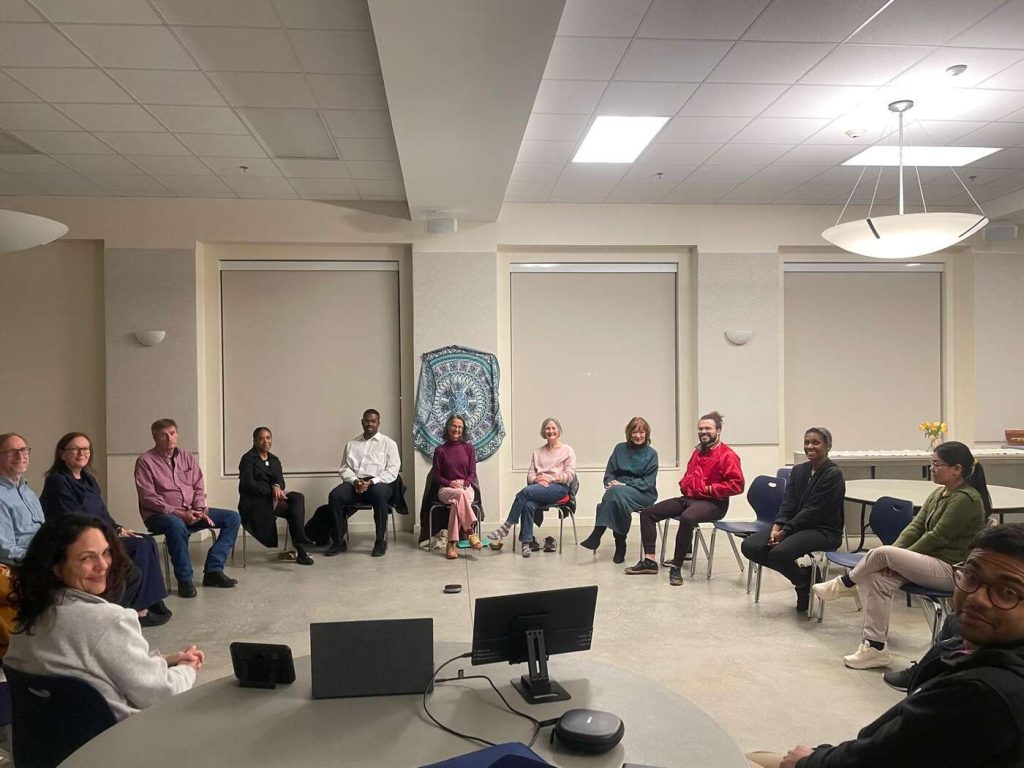
IMH draws a diverse cross-section of Houstonians — different ages, backgrounds, professions, and levels of practice. What members share is a genuine interest in practice and a warm welcome for newcomers. There is no gatekeeping, no required belief. Show up and you’re part of the community.
How long before I see benefits from meditation?
Most practitioners notice subtle shifts — slightly greater calm, more space between stimulus and reaction — within a few weeks of regular practice. Deeper benefits accumulate over months and years. Vipassana is not a quick fix; it is a lifelong path. The good news is that the practice itself is rewarding, not just the eventual insights.
About the Practice
What is the difference between Vipassana and mindfulness?
Mindfulness (sati) is one of the core tools within Vipassana practice. In popular usage, “mindfulness” often refers to secular stress-reduction techniques drawn from the tradition. Vipassana is the broader practice — using mindfulness as a tool to develop insight into the nature of experience, with liberation from suffering as the ultimate aim.
Do I need to practice at home between sittings?
Home practice deepens the work considerably — even 15–20 minutes daily makes a significant difference. That said, you don’t need a home practice to benefit from the Monday sittings. Come as you are. Over time, many practitioners naturally find themselves wanting to sit at home as well.
What should I do with my eyes — open or closed?
Either works. Traditional Vipassana is usually practiced with eyes closed or lightly lowered toward the floor. Eyes fully closed can sometimes increase sleepiness; a slightly downward, soft gaze can help. Try both and see what supports your attention better.
What happens if I fall asleep during meditation?
It happens to everyone, especially beginners. It usually means you’re tired. You can experiment with sitting upright rather than leaning back, practicing with eyes slightly open, or noting “sleepy, sleepy” as you drift. The teachers can offer more specific guidance.
Can I ask questions during the dharma talk?
Yes, please. The dharma discussion portion at the end of each Monday sitting is designed for questions. Newcomer questions are often the most valuable — they bring everyone back to fundamentals.
Online Attendance
How do I get the Zoom link?
The Zoom link is distributed in our weekly email newsletter and in our WhatsApp Community Channel. Subscribe to either to receive it each week.
Is the online experience as good as in-person?
Different, but genuinely valuable. Online participants are welcomed by name, participate fully in dharma discussion, and have the same access to the teachings. The main thing you miss online is the shared physical presence of the community. Many longtime members attend exclusively online and find it fully satisfying.
What do I need for online practice?
A device with Zoom installed, a reasonably quiet space, and a stable internet connection. Headphones help if your environment is noisy. Find a posture you can hold for 30 minutes — your usual meditation seat, or a comfortable chair.